


5 Signs Your Punches & Dies Need Grinding & Resharpening Services for Your Worn-Out Parts


Table of contents
Worn-out punches, dies, and other precision tooling can lead to dimensional inaccuracies, poor part quality, and costly production interruptions, issues that can impact both productivity and customer satisfaction. Recognising when your tooling requires professional regrinding or resharpening is crucial to maintaining consistent performance and extending tool life.
At NVT Technology, we provide comprehensive tooling solutions that include precision grinding and refurbishment for punches, dies, and forming tools. Our grinding services form a key part of the reconditioning process, ensuring every component meets strict tolerances, sharpness, and surface finish standards for consistent performance and extended tool life.
In this article, we highlight five key signs that your tooling or dies may require professional grinding services. These early indicators can help you prevent downtime, reduce waste, and maintain product quality if addressed promptly.
Key Takeaways
Identifying wear indicators such as uneven surfaces, burrs, or tool misalignment allows timely intervention. Professional grinding restores dimensional accuracy, prevents part defects, and reduces unplanned maintenance.
Regrinding and resharpening restore geometry, parallelism, and edge sharpness, ensuring punches and dies operate efficiently for longer. This minimises the need for premature replacement and lowers overall tooling costs.
Professional grinding services help maintain exact tolerances and surface finishes, ensuring consistent part accuracy and high-quality output in every production run.
Properly ground tools require less forming force, reduce friction, and improve material flow — resulting in smoother operations, less rework, and better energy efficiency across production cycles.
Restore correct punch–die clearance to prevent out-of-tolerance holes/slots.
Reduce burr height and stabilise press tonnage after resharpening.
Professional Grinding Services in Singapore

Professional Grinding Services for tool & die components restores worn punches, dies, buttons, and plates to spec—correcting geometry, clearance, and edge quality.Over time, repeated stamping and forming operations cause wear on critical surfaces, resulting in poor part quality, dimensional drift, and production inefficiencies. Precision grinding helps restore these components to exact tolerances and extends their usable lifespan.
This process is crucial in the tool and die manufacturing, precision engineering, and metal stamping industries, where even slight deviations in tool geometry can result in product defects or production downtime.
Key aspects of professional grinding for tool and die components include:
Dimensional Restoration: Regrinding worn punches and dies to restore the correct size, clearance, and geometry.
Edge Resharpening: Restoring clean cutting edges to improve shearing performance and reduce burr formation.
Surface Finishing: Refining die surfaces to ensure smoother forming and reduce friction during production.
Parallelism and Flatness Correction: Maintaining tight tolerances between mating surfaces to prevent misalignment.
Inspection and Quality Control: Conducting precision measurements to ensure restored tools meet production tolerances.
Re-clearancing: Set correct punch–die clearance for current material/thickness.
Jig grinding: Requalify die buttons/ID features and bearing/land length.
Professional grinding not only extends the life of punches and dies but also maintains consistent part quality and reduces tooling costs. Regular resharpening helps manufacturers prevent tolerance drift, minimise scrap, and ensure stable production output — key to sustaining precision in every production run.
5 Signs You Need Professional Grinding Services
Grinding plays a critical role in maintaining the precision and performance of tools and dies used in stamping, forming, and metalworking applications. Over time, continuous production causes wear on punches, dies, and plates, resulting in dimensional inaccuracies and product defects. Recognising the early signs of wear allows timely regrinding and resharpening, preventing tolerance drift, downtime, and scrap.
Worn or Uneven Tooling Surfaces
One of the earliest indicators that your punches and dies require professional grinding or resharpening is when you start noticing inconsistent part quality or out-of-tolerance results. This usually occurs due to uneven wear, rounding of edges, or surface damage — all of which impact the precision and alignment of your tooling set.
Check burnish-to-fracture ratio and burr height trends.
Issue | Cause | Impact | Why Professional Attention is Needed |
Inconsistent product dimensions | Uneven or worn punch and die surfaces; changes in die land or bearing length | Parts fail tolerance checks, increasing rejection rates | Regrinding restores flatness, bearing geometry, and sharpness to ensure consistent forming or cutting |
Burrs or rough edges on finished parts | Dull or chipped punch edges; worn edge radius | Causes extra deburring work and damages part surface | Resharpening restores crisp edges and controlled radius, ensuring clean shearing |
Uneven forming or cutting pressure | Tool misalignment or surface wear | Leads to part deformation and premature tool failure | Precision grinding re-establishes alignment and uniform contact between punch and die |
Polished or rounded tool edges | Gradual wear from repeated cycles; excessive edge radius growth | Reduces cutting efficiency and dimensional accuracy | Professional grinding restores proper edge geometry and cutting sharpness |
Excess friction or sticking during operation | Galling or surface scoring on dies; worn die land | Increases heat, slows production, and affects material flow | Reconditioning smooths tool surfaces and restores die land finish to prevent adhesion |
Excess burnish length on stamped edges | Edge rounding and die wear | Out-of-spec edge quality and dimensional drift | Resharpen and reset punch-to-die clearance to restore crisp shear and correct burnish ratio |
Addressing wear early through precision regrinding prevents tolerance drift, reduces scrap, and extends tool life — ensuring consistent quality and productivity across every production cycle.
Unusual Noises or Vibrations

In stamping and forming, new clicks, snaps, or chatter usually point to a tooling system issue—worn guide pins/bushings, weak or uneven stripper force, or punch–die misalignment/clearance drifting out of spec. Addressing the tooling stack (not the press) with resharpening, re-clearancing, and alignment checks prevents edge chipping, slug pulling, and parts going out of tolerance.
Issue | Likely Cause | Impact on Product or Tool | Why Professional Grinding Is Needed |
Unusual Noises (clicking/snap at breakthrough) | Dull punch edge or incorrect clearance → uneven shear load | Burr height rises, rollover increases, hole/profile drift | Resharpen edge and reset clearance to restore even load and clean shearing |
Excessive Vibration During Stamping | Guide pin/bushing wear or die set misalignment | Edge micro-chipping, accelerated wear, dimensional inaccuracy | Jig-grind/realign guides, restore flatness/contact, re-qualify tool concentricity |
Rattling or Chattering in Tool Holders | Loose retainers or insufficient stripper force causing slug pulling | Inconsistent punch entry, part tolerance variation, surface marks | Re-seat/replace retainers, polish punch flanks, consider TiCN and adjust stripper force |
Irregular Impact Marks on Parts | Uneven die surface or worn cutting edges | Affects part flatness and surface finish | Surface regrind ensures uniform contact and consistent output |
Reduced Punch Lifespan | Friction and shock from dull or uneven tools | Frequent tool replacement and downtime | Resharpening reduces stress and extends tool life |
Slug Pulling | Insufficient clearance or weak stripping action | Slugs adhere to punch tip, causing double-hits, chipped edges, and poor hole quality | Increase clearance, polish punch flanks, apply TiCN coating, and verify stripper pressure to prevent recurrence |
Addressing these early signs through precision grinding and resharpening helps maintain product tolerances, protect die sets from further wear, and ensure consistent performance during production.
Decreased Performance and Efficiency
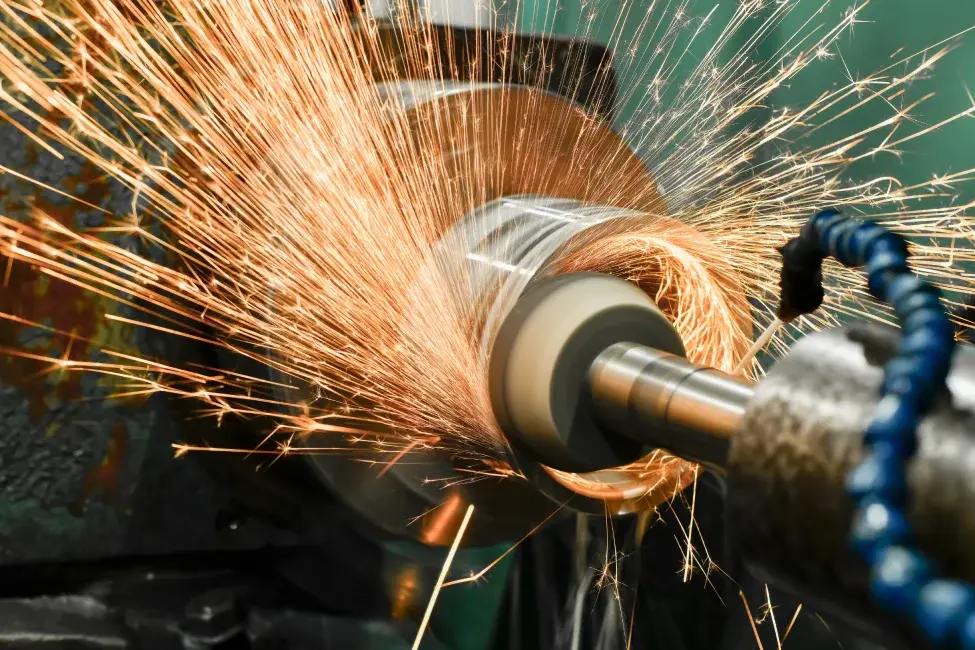
When your tooling or die sets start producing inconsistent or out-of-tolerance parts, it’s often a sign that the punch and die edges have worn down or that the clearance between components has changed. Even minor deviations raise burr height, shift hole/slot dimensions, and increase press tonnage, leading to out-of-tolerance parts and higher scrap/rework.
Symptom (on Tool / Die) | Impact on Production | How Precision Grinding or Resharpening Fixes It |
Increased forming or punching force required | Rising press tonnage causes accelerated edge wear, chipping, and dimensional drift; leads to higher scrap and rework. | Restores correct edge geometry and sharpness for smoother material flow |
Press tonnage trending higher | Dull edges or incorrect clearance increase shear resistance, risking edge chipping, snap-through variation, and off-tolerance parts. | Resharpen edges and reset clearance to restore uniform load and dimensional consistency. |
Burrs or uneven cut edges on parts | Out-of-spec burr height or rollover causes secondary operations, tolerance loss, and Cpk reduction on critical features. | Regrinds cutting edges to restore clean shearing and reduce burr formation. |
Dimensional variations in finished parts | Hole/slot Ø drift, taper, or profile error → failed gauge checks and line stoppages. | Restores correct clearance between punch and die, ensuring consistent part dimensions |
Frequent press stoppages for adjustments | Operator compensation for wear or clearance issues causes inconsistent part quality and throughput loss. | Precision regrinding maintains tool uniformity, reducing the need for manual corrections |
Rough or matte surface finish on formed parts | Surface drag or scoring leads to poor cosmetic finish and dimensional inconsistencies in mating parts. | Surface grinding or polishing restores die smoothness for consistent part finish |
Typical outcome after resharpening: burr height ↓ from >0.05 mm to <0.02 mm (material-dependent).
Regular tool resharpening and regrinding not only improve precision but also reduce scrap rates, extend the service life of your tooling, and keep production running efficiently. At NVT Technology, we specialise in restoring the geometry, finish, and dimensional integrity of punches and dies — ensuring your tooling continues to deliver reliable, high-quality results across every production run.
Frequent Breakdowns and Downtime

When tooling systems or die sets require repeated maintenance or adjustment, it often indicates that critical surfaces or fits have worn beyond tolerance. Over time, wear on punch faces, die cavities, guide pins, or retainers can lead to misalignment, uneven forming pressure, and product defects. These issues not only disrupt production flow but also shorten tool lifespan.
Recurring Symptom | Underlying Tool or Die Condition | Impact on Production | Grinding / Resharpening Solution |
Burrs or cracks appearing frequently on punched parts | Dull or chipped punch edges | Increased scrap rate and reduced part quality | Edge regrinding restores sharpness and cutting precision |
Inconsistent clearance between punch and die | Worn die openings or guide misalignment | Out-of-tolerance products and excessive tool wear | Regrind die profiles and realign components to original tolerances |
Excessive forming pressure or press overload alarms | Uneven or worn forming surfaces | Risk of tool damage and shortened press lifespan | Surface regrinding restores even contact and uniform pressure distribution |
Difficult part ejection or sticking | Worn or rough die cavity surfaces | Slower cycle times and tool marks on parts | Finish grind or polish restores smoothness for consistent part release |
Frequent need for tool setup recalibration | Degraded mounting surfaces or uneven die shoe contact | Lost productivity due to repeated adjustments | Regrinding restores flatness and proper seating between tool components |
Recurring downtime in tooling operations is often due to wear and surface degradation — not operator error. Through precision regrinding and refurbishment, NVT Technology restores tool geometry, fit, and alignment, allowing dies and punches to run longer, maintain accuracy, and minimise unplanned stoppages.
Visible Wear and Tear
Visible wear on punches, dies, and tooling surfaces is one of the most reliable indicators that maintenance or resharpening is due. Ignoring these signs can lead to poor part quality, dimensional inaccuracies, and shortened tool life. Identifying and addressing wear early through professional grinding and polishing ensures consistent performance and extended die longevity.
Visible Sign | Impact on Tooling Performance | Recommended Grinding / Resharpening Remedy |
Chipped or Rolled Punch Edges | Causes burrs, poor shearing quality, and part deformation | Edge regrinding restores cutting sharpness and maintains clearance accuracy |
Scoring or Grooves on Die Cavities | Results in drag marks, poor part finish, and tool sticking | Precision cavity regrind and polish restore surface smoothness |
Cracks or Pitting on Tool Faces | Leads to uneven force distribution and premature tool failure | Controlled regrind and lapping remove surface defects and restore flatness |
Burn Marks or Discolouration on Tooling Surface | Indicates overheating, hardness loss, or improper lubrication | Surface regrind to remove the heat-affected layer and restore hardness uniformity |
Uneven Wear on Guide Pins or Bushings | Causes misalignment between punch and die, leading to tolerance issues | Regrind or replace worn components to restore alignment and concentricity |
Surface Corrosion or Rust Spots | Affects tool precision and increases friction during operation | Polish or surface regrind to remove oxidation and reapply protective coatings |
At NVT Technology, visible wear is more than a cosmetic issue — it’s an early warning that your punches and dies may be drifting out of tolerance. Through precision regrinding, lapping, and polishing, our team restores tooling to its original geometry, ensuring consistent part accuracy, reduced downtime, and extended tool life.
Recognise When Precision Grinding Matters in High-Accuracy Tooling

Precision grinding is a vital capability within advanced tooling and precision machining. It ensures consistent edge sharpness, dimensional accuracy, and fine surface finish for punches, dies, and other high-precision components. Over time, normal wear can lead to edge rounding, surface scoring, or clearance loss, all of which affect part tolerance and shorten tool life.
When dimensional drift, uneven shear edges, or forming defects begin to appear in production, these are clear indicators that tooling requires controlled reconditioning, not ad hoc sharpening. Attempting to regrind in-house without proper fixturing, clearance control, or inspection can compromise geometry, leading to poor alignment and reduced tool performance.
At NVT Technology, precision grinding forms part of our integrated toolmaking and refurbishment capability. Every rework follows the same process discipline as our new tool builds, combining precision machining, jig grinding, and metrology to restore as-built accuracy and performance.
Our deliverables typically include:
Resharpening and re-clearing punches and dies (material-specific)
Jig grinding of die buttons and internal diameter features to restore die land and bearing length
Inspection report with edge radius, burr height, and clearance conformity notes
Through these processes, NVT ensures that refurbished tools meet the same dimensional integrity, surface finish, and operational reliability as original builds, supporting consistent part quality and extended tooling lifespan.
Contact NVT Technology today to learn more about our precision machining and tooling solutions designed for high-accuracy production environments.
Frequently Asked Questions
What are the early signs my punches & dies need resharpening?
Early warning signs include rising burr height, dimensional drift in holes or slots, slug pulling, edge chipping, and increasing press tonnage during production. These indicate a loss of sharpness or an incorrect clearance between the punch and die. Addressing these signs early through controlled resharpening and re-clearancing helps maintain clean shearing and consistent dimensional accuracy.
How do unusual noises relate to tooling issues?
Unusual noises such as clicking, snapping, or chatter during stamping often point to guide pin or bushing wear, die set misalignment, or stripper force issues. These conditions create uneven loading and accelerate tool wear. Acting early to realign, regrind, or restore contact surfaces prevents edge damage and ensures stable forming and punching performance.
What impact does decreased performance have on tooling?
Declining tool performance leads to increased scrap and rework, premature punch-and-die replacement, and accelerated die-set wear. Instead of general press or machinery damage, the main concern is dimensional inconsistency and reduced tool life. Regular precision regrinding keeps edges sharp and maintains the tool’s geometry for longer service intervals.
Why address visible wear on tooling promptly?
Visible wear, such as edge rounding, often conceals deeper microcracks, die-land erosion, or coating breakdown on TiN-, TiCN-, or AlCrN-treated tools. Ignoring these signs allows wear to propagate into the substrate, leading to more extensive rework or tool replacement. Early intervention through precision grinding and inspection preserves coating adhesion and restores optimal tool geometry.
How does reduced surface finish on parts point to tooling?
A dull or inconsistent surface finish on formed parts usually indicates die cavity scoring, worn polishing, or incorrect clearance between punch and die. In such cases, controlled surface regrinding, polishing, and re-clearancing restore smooth contact surfaces and ensure consistent part finish and dimensional accuracy.


Comments